
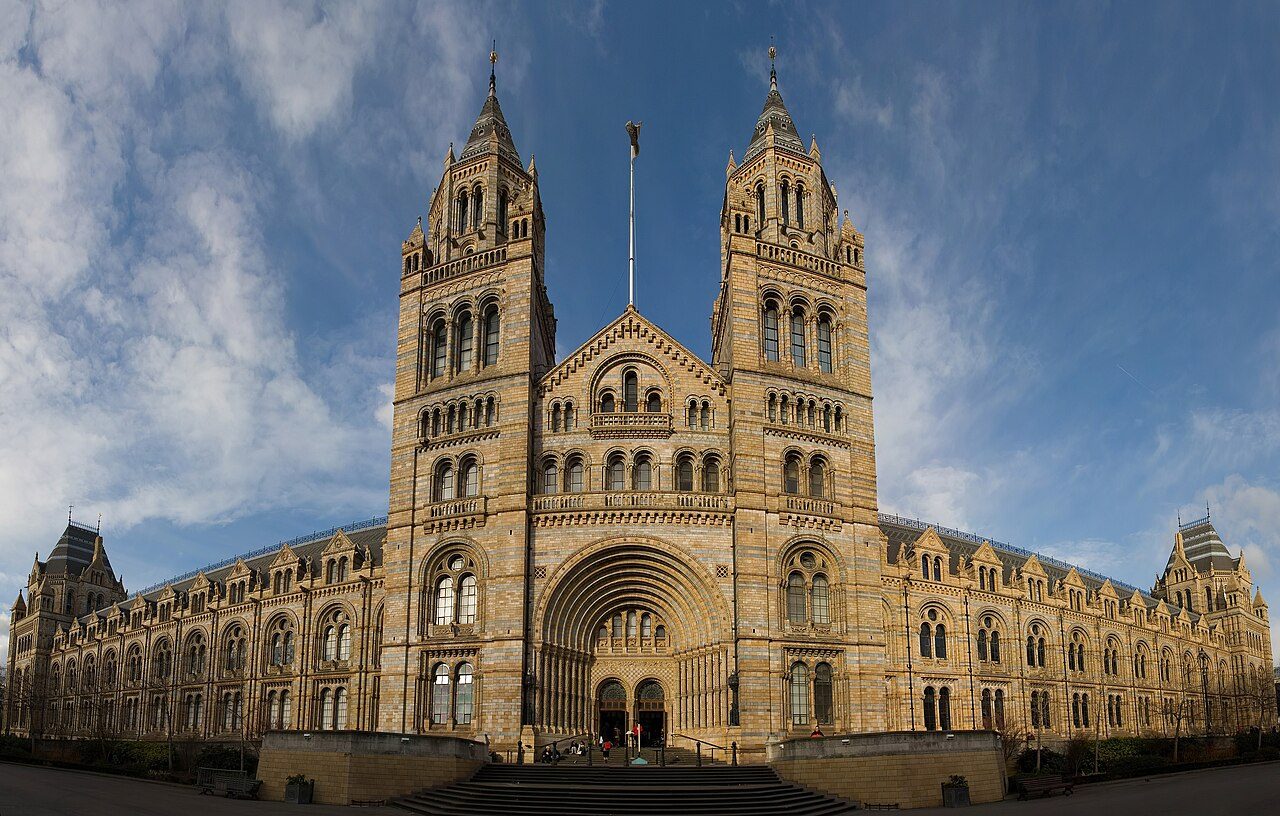
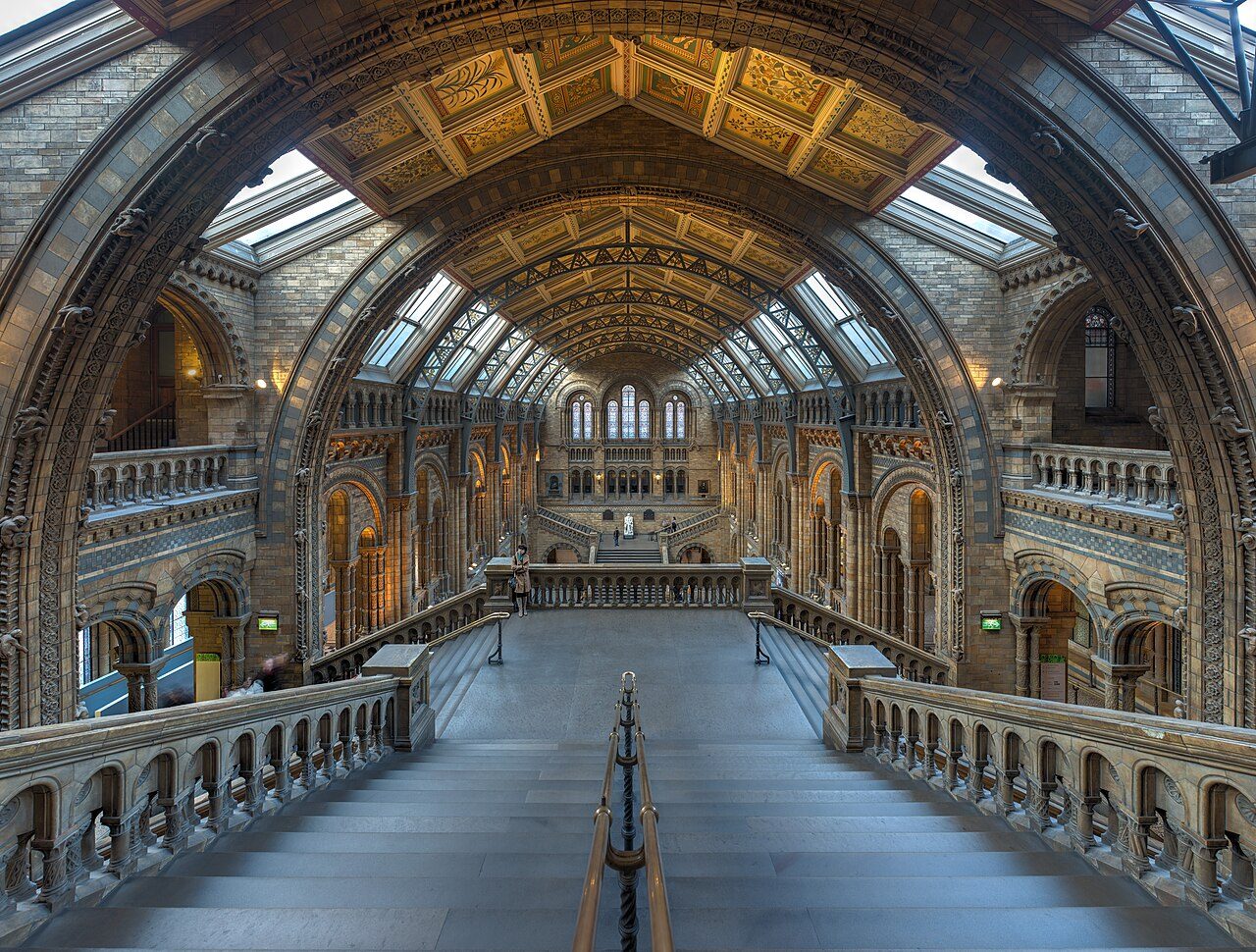
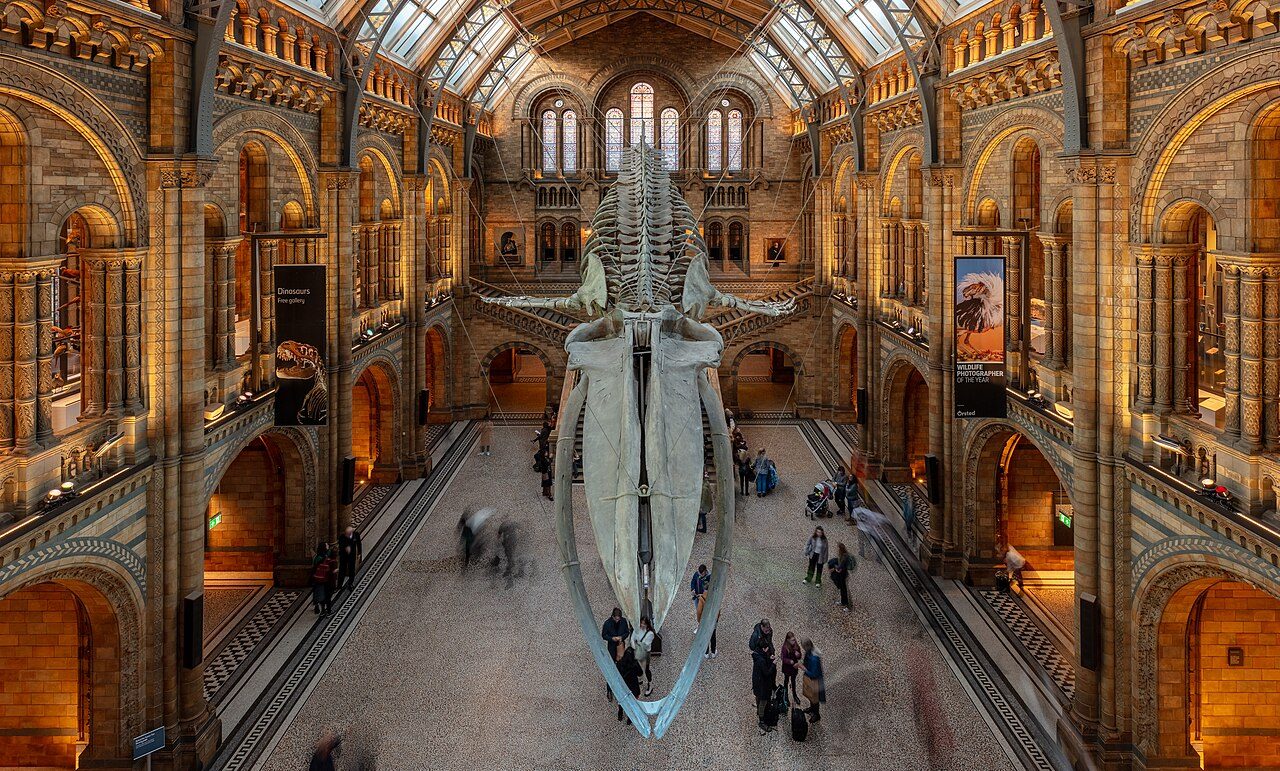
You walk through a grand Romanesque arch into a vast hall, and look up. Suspended from the ceiling, diving through the air as if through the ocean, hangs the skeleton of a blue whale, more than 25 metres long. Around her, the hall rises like a cathedral, with arches, columns and staircases, and the walls are covered with carved terracotta animals and plants: monkeys climbing up the pillars, fish swimming across the arches, birds nesting in the stone. It's one of the most spectacular museum spaces in the world.
The Natural History Museum in London holds one of the greatest collections of natural history on Earth, with around 80 million specimens, from dinosaur fossils to meteorites. Entry to its main galleries is free. This guide explains its story and highlights.
A cathedral to nature
The museum's collection began as part of the British Museum, starting with the specimens left to the nation by Sir Hans Sloane in the 18th century. As the collection grew, the naturalist Sir Richard Owen campaigned for a separate museum, a cathedral to nature where people could marvel at the variety of life.
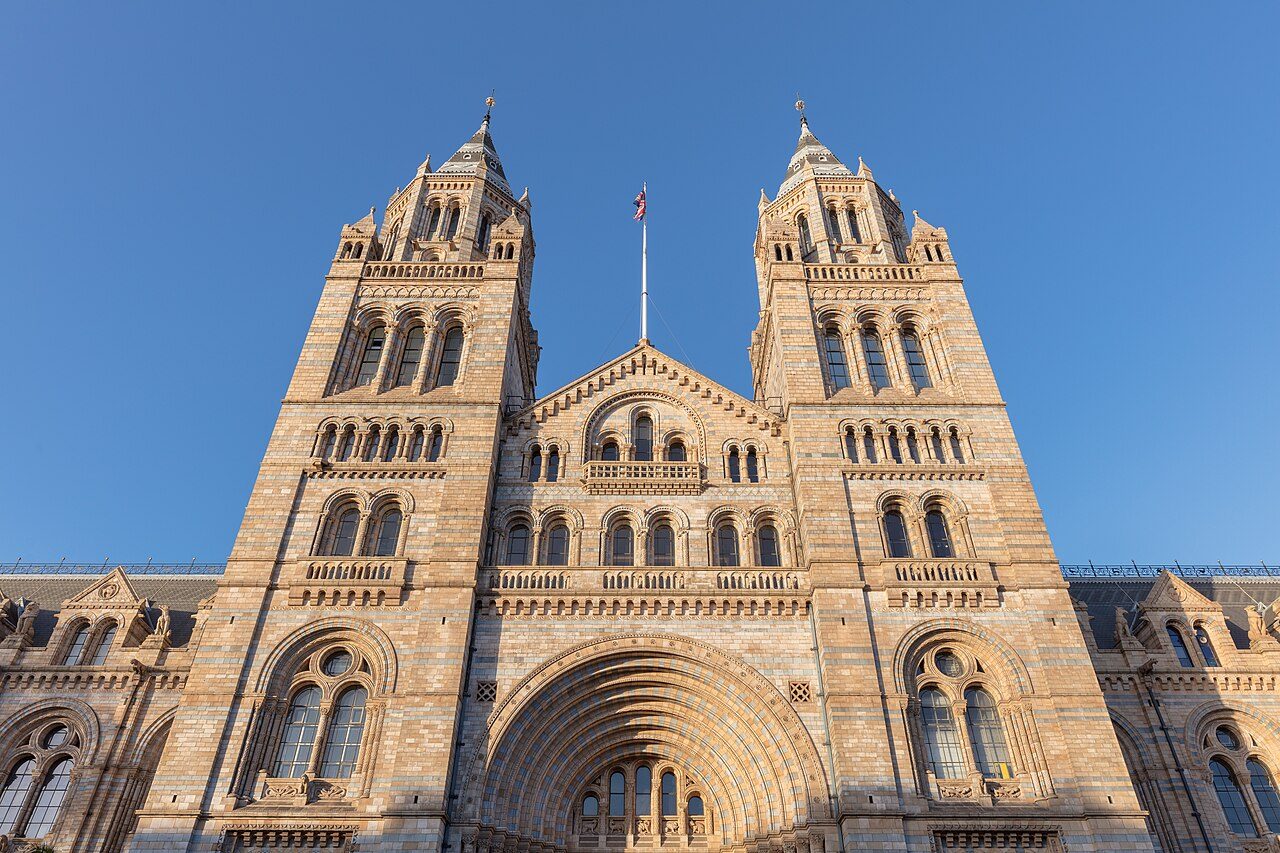
The building, designed by the architect Alfred Waterhouse, opened in 1881. It's decorated inside and out with terracotta carvings of animals and plants. Waterhouse placed living species on the western side of the building and extinct ones on the eastern side, reflecting the scientific ideas of the time.
Hope the blue whale
For decades, the museum's central Hintze Hall was home to Dippy, a famous cast of a Diplodocus skeleton. In 2017, Dippy was replaced by the real skeleton of a blue whale, named Hope, as a symbol of humanity's power to shape a sustainable future. The blue whale, the largest animal ever known to have lived, was hunted close to extinction in the 20th century, and its protection is a conservation success story.
Dinosaurs
The Dinosaurs gallery is one of the museum's most popular, with skeletons, fossils and a life-sized animatronic Tyrannosaurus rex that roars and moves. Elsewhere, you'll find the skeleton of a Stegosaurus, one of the most complete ever found, and many other fossils that tell the story of life on Earth over hundreds of millions of years.
Earth and space
In the Earth Hall, an escalator carries you through the inside of a giant sculpted globe into the Volcanoes and Earthquakes gallery, where you can experience a simulated earthquake. Nearby, the Treasures gallery displays some of the museum's most precious objects, including a first edition of Darwin's On the Origin of Species, meteorites and rare minerals.
Darwin's legacy
The Darwin Centre houses millions of specimens preserved in alcohol and other collections used by scientists from around the world. The museum is still an active research institution, studying biodiversity, climate change and evolution.
Things not to miss
- ✓See Hope the blue whale in Hintze Hall.
- ✓Meet the animatronic T. rex in the Dinosaurs gallery.
- ✓Ride the escalator through the giant globe in the Earth Hall.
- ✓Look for the terracotta animals on the walls and pillars.
- ✓Visit the Treasures gallery.
- ✓Walk through the museum's wildlife garden.
How to get there
The museum is in South Kensington, next to the Science Museum and the Victoria and Albert Museum. South Kensington tube station is a few minutes' walk away, connected by an underground tunnel.
Tickets and opening hours
Entry to the main galleries is free, though booking a free timed ticket may be recommended at busy times. Special exhibitions, such as Wildlife Photographer of the Year, charge a fee. Check current details before you go.
Best time to visit
Weekday mornings outside school holidays are the quietest. Weekends and school holidays can be extremely busy, especially in the Dinosaurs gallery.
Frequently asked questions
Is the Natural History Museum free? Yes, the main galleries are free.
Where is Dippy the dinosaur? Dippy left the museum in 2017 and has since toured the UK.
How long should I spend there? At least three hours.
Stand beneath Hope the blue whale in the great hall, surrounded by carved animals in stone, and you'll feel both the wonder and the fragility of life on our planet.

Comments
Been here, or planning to go? Share a tip or ask a question.
Sign in with Google to comment or vote. Your email is never shown.